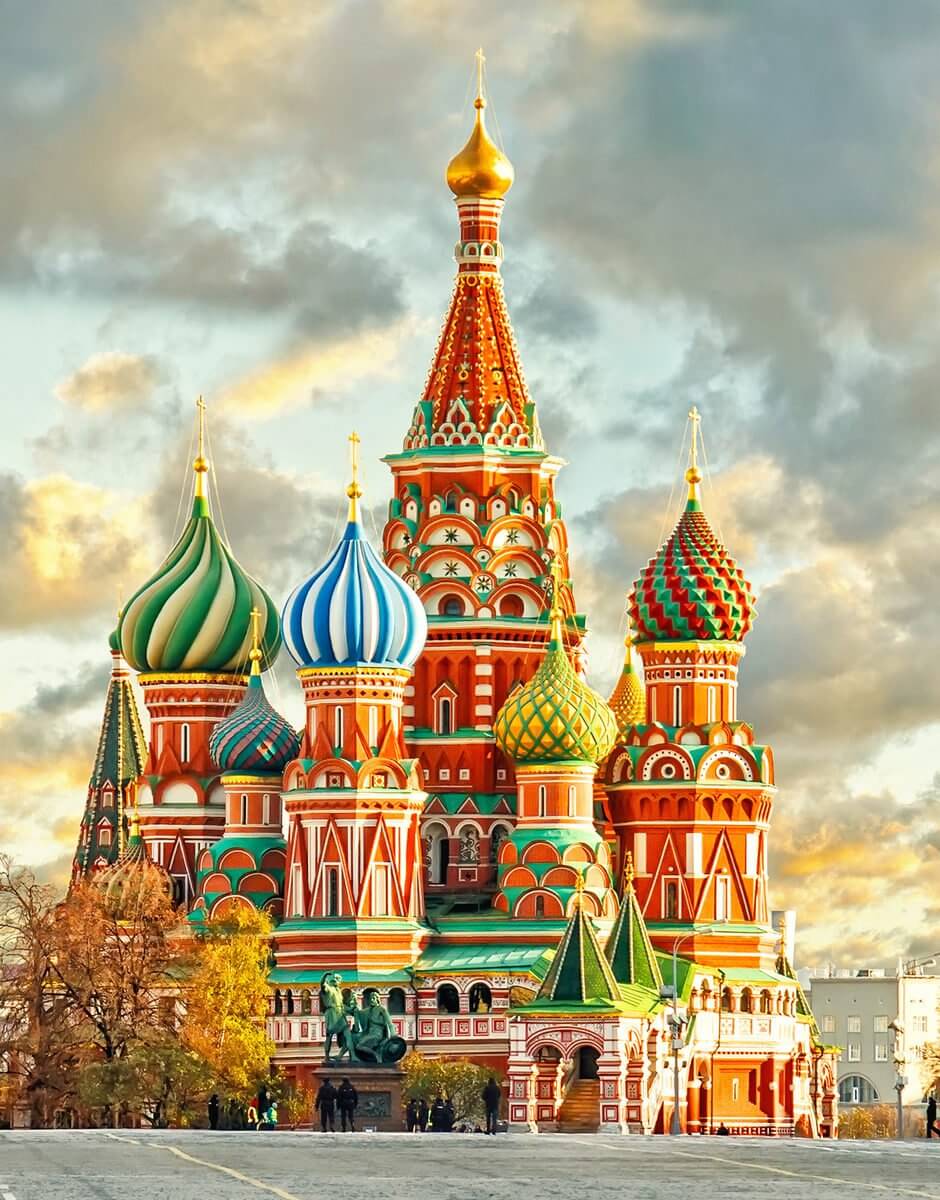
To the east of the Spasskaya Tower, on the descent to the Moscow River, on an artificial oval terrace, one of the masterpieces of Moscow architecture rises: the Church of the Intercession of the Blessed Virgin Mary, which is on the Moat, better known under the name of St. Basil.
Tsar Ivan IV built a building in honor of the capture of Kazan by Russian troops.
After the victory in 1552, the wooden church in 1555-1560 was replaced by a brick church built by the Pskov architect Postnik Yakovlev. The work lasted one hundred twenty-five years. Domes of aisles differ one from another. The drawings of large dome bulbs are unique. The domes were originally helmet-shaped, but by the end of the 16th century they had become bulbous. The coloring of the domes was established in the middle of the XIX century.
In 1680, by order of Tsar Fyodor III (Fedor III Alekseevich) and Patriarch Joachim, all the old, worn out wooden churches that were on Red Square were destroyed. In exchange, new chapels were installed (about twenty) around the Intercession Church. Over time, most of the chapels disappeared and, in 1783, there were no more than eleven.
In September 1918, the abbot of the cathedral was shot. All the bells were melted, and the Cathedral was closed. In 1930, Lazar Kaganovich proposed the destruction of the Pokrovsky Cathedral in order to facilitate automobile traffic on Red Square.
Pokrovsky Cathedral today is known as St. Basil’s Cathedral. The latter was born in 1469. At the age of 16 he joined the spiritual life. All year round he went without clothes and asked for alms. After his death, in 1552, he was buried next to the Intercession Church. Many blessings were attributed to St. Basil.
Over time, his fame and holiness overshadowed the memory of the capture of Kazan. The Church of the Intercession was increasingly referred to as St. Basil.